
Mario Gallavotti, an adviser to Gianni Infantino, reportedly helped build FIFA’s Saudi relationship and exercised extensive influence at CAF.
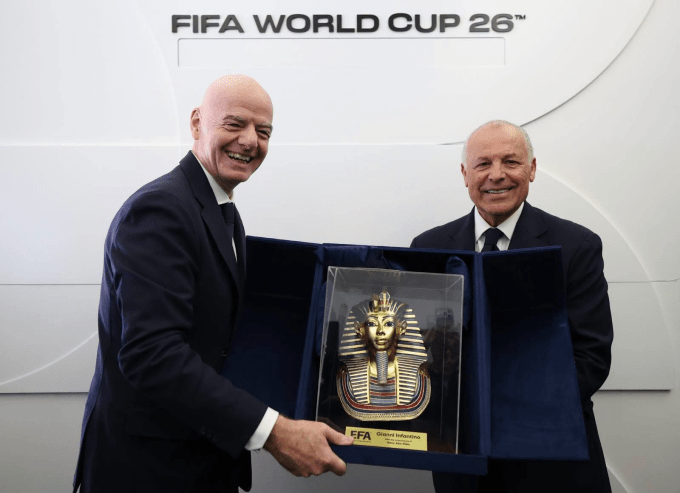
The Egyptian Football Association (EFA) has become one of Gianni Infantino’s clearest defenders during FIFA’s governance crisis. That backing is not without reason, as FIFA invested at least $6.65 million in the EFA’s headquarters and technical centre, inaugurated by Infantino in 2021.
A recent Politico investigation placed the Italian lawyer at the centre of several major political and commercial decisions under Infantino. The report described Mario Gallavotti as one of the FIFA president’s most influential advisers. His relationship with Infantino stretches back more than two decades.
Former FIFA audit committee chair Tomaž Vesel said Gallavotti “has a more political role than anybody in FIFA.” Gallavotti initially managed the secretariats supporting FIFA’s disciplinary, appeal, audit and ethics committees, and moved into Infantino’s office as a senior adviser in 2021.
Gallavotti arranged meetings between Italian and Saudi football officials in Rome in April 2021. The talks explored a joint bid for the 2030 World Cup, according to Politico.
Saudi Arabia needed a partner from another confederation because Qatar had hosted the 2022 tournament. FIFA’s rotation rules presented an obstacle to another Asian World Cup eight years later.
Saudi officials subsequently considered partnerships with Italy, Egypt and Greece. Italy rejected the proposal amid concerns over Saudi Arabia’s human-rights record and tensions with Egypt over the abduction, torture, and murder of Italian researcher Giulio Regeni at the hands of state security officers.
The rejection then damaged Italy’s relationship with Infantino’s administration. Riyadh then explored a different combination with Egypt and Greece, with the Saudi capital reportedly offering to finance new stadiums in Egypt and Greece in exchange for staging approximately 75% of the tournament in Saudi Arabia.
Saudi Arabia later abandoned its 2030 plans and pursued the following tournament alone. FIFA eventually awarded the 2034 World Cup to Saudi Arabia by acclamation.
However, Gallavotti also played a central role in developing FIFA’s wider commercial relationship with Saudi Arabia. That relationship includes FIFA’s four-year agreement with state-owned energy company Aramco. The partnership runs until the end of 2027 and covers the 2026 men’s and 2027 women’s World Cups.
Gallavotti is also connected to the regional broadcasting dispute that accompanied the Saudi-led blockade of Qatar.
Saudi-based pirates targeted Qatar’s beIN Sports, which owns major football rights across the Middle East and North Africa. FIFA and other rights holders condemned the piracy during the 2018 World Cup.
Separately, Egypt’s competition proceedings against beIN and CAF began in 2016, before the Saudi-led blockade. An Egyptian Competition Authority (ECA) submission to the Organisation for Economic Co-operation and Development (OECD) alleged exclusivity, tying broadcast packages, the absence of an open tender and the effect on Egyptian broadcasters and viewers.
Qatari officials are said to have raised concerns with FIFA about Gallavotti’s contacts with Egyptian regulators after Egypt moved against beIN.
A regional official who joined calls between CAF and beIN also told Politico that Gallavotti appeared to control the African confederation between 2018 and 2021, reportedly leading discussions despite holding no formal position at CAF.
That period included FIFA’s direct intervention in CAF’s administration. FIFA appointed then-secretary general Fatma Samoura as its General Delegate for Africa from August 2019.
A joint FIFA and CAF statement gave Samoura authority to oversee CAF’s operational management, governance and competitions. FIFA also launched a forensic audit of the Cairo-based confederation.
Gallavotti’s reported influence now carries added significance as Infantino seeks African and Saudi support during FIFA’s current leadership crisis.
The crisis followed Infantino’s unsuccessful “FIFA Forward Enterprise proposal.” The plan would have transferred FIFA’s leading commercial rights into a new company and sold a 20% stake to private investors.
Gallavotti disclosed details of the secret plan to a New York industry figure, which triggered the opposition that forced FIFA to withdraw the proposal.
As KingFut reported in July, UEFA threatened to boycott FIFA competitions over the plan. UEFA subsequently declared that it had lost confidence in Infantino.
FIFA has since confirmed that it permanently abandoned the project. The EFA described the reversal as evidence of “true leadership” and reaffirmed its confidence in him. Likewise, the Saudi Arabian Football Federation broke with the Asian Football Confederation’s critical position. It announced its continued support for Infantino and called for “direct dialogue” among football officials.
CAF has also formally backed the FIFA president. Its Executive Committee said it had unanimously reconfirmed its support and thanked Infantino for his work in African football. However, sources say only four CAF officials explicitly supported Infantino during the meeting.
EFA president Hany Abo Rida then joined the heads of the Qatari, Lebanese, Moroccan, Sudanese and Mauritanian associations in an August 13 statement backing Infantino.
CAF controls 54 of FIFA’s 211 votes, making Africa central to Infantino’s re-election campaign. FIFA will hold its presidential election in Rabat on March 18, 2027. Infantino remains the only declared candidate, with nominations closing in November.